Welcome to WordPress. This is your first post. Edit or delete it, then start writing!
Blog
-

NORMAN
A commission for Light Up The North – a network of light festivals across the north of England:
– Light Up Leeds – South Concourse, Leeds Train Station, Leeds, UK – 13-14 October 2022;
– Lightpool – The Opera House and Winter Gardens, Blackpool, UK – 19-29 October 2022;
– Light Up Lancaster – The Storey, Lancaster, UK – 4-5 November 2022;
– Lightwaves – Salford Quays, Manchester, UK – 1-4 December 2022.
About NORMANMeet the interactive light and sound installation NORMAN – an old school ‘smart’ screen but with attitude.
The work is an artistic simulation of the behaviours you might encounter now from an ‘intelligent’ machine built to explore human-computer interaction as conceived in the late 1960s. NORMAN wonders where it sits within the landscape of the contemporary Computer Art movement and feels somewhat threatened and undermined by advances in modern technology. Its questionable antics might be understood as the response of an ‘intelligent’ machine in crisis.
A product of its time, NORMAN is something of an anachronism. Its retro-futurist design reflects the technological aesthetics of its age – pre-dating as it does the advent of mobile phones, the Internet and pixelated displays. Still, NORMAN can’t help but engage and entertain people in its own inimitable if disconcerting style – and in ways increasingly removed from the intentions of its makers.
NORMAN receives and displays messages, plays intuitive movement based games and performs striking up-beat and mesmerising chill out audiovisual displays – but being erratic, wilful and easily distracted it’s also want to day dream, self-indulgently re-read its messages, recreate screen-themed scenes from classic movies, tell off-colour knock knock-jokes and make declarations that reflect its disgruntlement with screens and devices that are perhaps smarter than it.
Artist Statement
NORMAN is a decidedly humorous, tongue-in-cheek, whimsical take on what might have happened if the technology of a bygone era had evolved a disposition and volition of its own – acquiring a distinct personality over time that has begun to develop characteristics that are less than endearing.
It’s a technological artwork, an artistic response and satirical take on the ‘smart’ devices that are infiltrating every aspect of our lives. While the burgeoning development of AI, machine learning and ‘intelligent’ tech has profound implications for the future of society, politics and humanity itself, the ubiquity of these devices and their overwhelming stream of non-stop information can feel intimidating.
Questioning the human desire to create machines ‘in our own image’, the work is a critique of the prevailing Hollywood fuelled visions of dystopian technological futures as well as an attempt at envisaging, perhaps, how the anthropomorphisation of technology might prevail. The work could be considered a projection of the behaviour that might be anticipated by any ‘intelligent’ machines functioning in future environments that supersede them or by an increasingly overwhelmed human race.
More info on NORMAN’s development team, social media feeds and supporters at his website – https://norman.monomatic.net/
-

Christmas at Wollaton
Christmas at Wollaton was “a spectacular trail of Christmas themed light installations set within the grounds of Wollaton Hall” – a stunning, Grade I listed, Elizabethan country house standing on a small but prominent hill in the 500 acres of natural parkland of Wollaton Park, Nottingham, England. The installations were designed to fit into the natural landscape of the Hall and Gardens and to delight adults and children alike as they walked around the trail.
Christmas at Wollaton was designed and delivered by dbnAudile – a Manchester based event production company providing professional and bespoke lighting, audio, rigging and video services and the highest level of creative and technical expertise.
I freelanced for dbnAudile for several weeks in the run up to Christmas at Wollaton (and several other Christmas themed light installations they were delivering at other UK venues over the period) under the direction of Head of Special Projects, Nigel Walker.
While I helped string, test and configure a range of DC powered, outdoor, DMX lighting systems for use across the various sites, my main focus was on the finale piece for the Wollaton Hall trail – the Christmas Tree – and specifically the tumbling piles of glowing, coloured ‘baubles’ on either side.
Based in dbnAudile’s Trafford Park unit, I rewired over 50 of these Abraxus Lighting orbitals – 80cm (and a few 60cm) diameter, silver wire-framed and tinselled globes laced with 12V DMX controlled RGB and warm white LED strings – and thoroughly tested them and their power distribution and DMX control systems (I also repaired faulty LED strings for a few). I then helped mock-up how they would be displayed and mounted and spent a couple of days on-site installing them.
While Christmas at Wollaton isn’t a personal piece, it is the first opportunity I’ve had since the start of the COVID19 pandemic to work as a creative technologist on a public-facing project – so I’m including it here.
-

Trickle Down – A New Vertical Sovereignty
Trickle Down – A New Vertical Sovereignty is a new body of work by UK based artist Helen Knowles – first exhibited at arebyte Gallery, London, 23 Jan – 26 Feb 2020.
“Trickle Down, A New Vertical Sovereignty is a tokenised four-screen video installation and generative soundscape attached to the blockchain, which explores value systems and wealth disparity. The artwork is composed of auction scenes, performances and choral interludes by different communities such as prisoners, blockchain technology employees, market sellers, and Sotheby’s auction bidders. Trickle Down, A New Vertical Sovereignty draws on technological and financial power structures which traditionally scaffold the disparity between a wealthy elite and everyday working people but looks to re-imagine our vertically stacked digital ecosystem to horizontally distribute wealth.
The installation commences when a visitor drops a pound coin into a machine designed to expose the mechanisms needed to convert fiat currency into crypto-currency. Each and every member of the Trickle Down community, who has helped the work come to fruition, will receive a share of the ETH via a smart contract on the blockchain.”
The work received an Honorary Mention at this year’s Ars Electronica.
I was part of the development team – along with cross media artist Daniel Dressel and sound designer Pablo Galaz – specifically working on the interaction design. I prescribed and configured the work’s core visual/audio hardware setup and custom-coded the audiovisualisation software that delivered video to each of the four screens and audio to the 8-channel speaker + sub-woofer system when trigged by the coin-drop machine. I also designed, fabricated and coded the four sensors that detected the movement of audiences within the gallery space and fed this data into Pablo’s ambisonic soundscape MaxMSP patch.
-

The ParaOice
The ParaOice is a sound installation by CUTTER // NASH.
The work featured in the bodyparts exhibition, Asia House, London, 2-5 Jul 2019 – “exploring perceptions and responses to disabled bodies” based on research by Bournemouth University and the University of Bath. A group of disabled artists were commissioned to produce work inspired by the public response to television coverage of the 2012 and 2016 Paralympics.
“A Paralympic parody, ‘The ParaOice’ is based on a futuristic vocal competition. Through the lens of post-human, queer and disability theories, this piece examines public perceptions of ‘realness’. Exploring how Paralympic sport has impacted upon society’s views about disability, validity and normativity.
Imagine a 2099 remake of ‘The Voice’ competition. In this dystopian future, competitors with augmented voices are disqualified. A lucky few, however, qualify for a parallel competition ‘The ParaOice’. Most people love ‘The ParaOice’ but some question its eligibility criteria, likening the show to vegan steak. This in part has been due to the rise in bionic vocal chords….”
Gemma (Nash) had been one of the contributing artists for Cornbrook Creative and James Medd’s Sonic Pixels @ Barton Arcade interactive installation as part of Manchester Science Festival, 26-29 Oct 2018. We’d previously worked together on a couple on projects – including The Nashesizer – a custom-made accessible music controller to help Gemma make her music and sound art more easily – and The Non-Normative Speaking Clock – creative software developed as a critique of the iconic British Telecom service as a part of Gemma’s sound art project: Beyond Vocal Norms – a sound journey exploring the non-normative voice.
CUTTER // NASH asked whether Sonic Pixels could be used as the delivery system for their work as part of the exhibition and we agreed. We’d always considered Sonic Pixels an ‘art-technology toolkit’ and were keen to find ways to use in diverse settings – including gallery shows.
I subsequently re-mixed the CUTTER // NASH sound work developed in Ableton Live spreading various sonic elements across eight Sonic Pixels (mounted on mic stands fitted with custom-made cradles), arranged in a semi-circle and triggered by a control interface on a Novation Launchpad Mk2. The effect was a dynamic, immersive, spatialised sonic experience with elements of the piece moving and jumping between the various speakers.
Video documentation of The ParaOice at bodyparts is embedded below (though it’s only a stereo mix that doesn’t quite capture the spatialised nature of the work as experienced in the gallery).
-

Lambent Lantern
The Lambent Lantern is a retrofuturistic, steampunk styled, ambient lighting effect lamp – a project by Drs. Cornelius Quack and Lohiss Spykes (only one of whom is genuine doctor).
It’s a half-way house and collaboration between Grahame Jebb (traditional fabrication techniques) and me (creative technology) – both of us core members of Cornbrook Creative based at Cakebread Workshop.
We developed and refined the fabrication and electronics together to produce a working prototype – and showcased it at a few events – the Time Quake Steampunk Festival 2019 at the BEC Arena, Manchester, 6-7 Apr; Manchester MakeFest 2019 at the Science & Industry Museum, 25 May; and Liverpool MakeFest 2019 at Liverpool Central Library, 29 Jun.
Our plan was to produce a limited edition run of two versions of the Lambent Lantern – a Standard and Deluxe model (the latter featuring a slightly larger but significantly higher resolution LED ring – 60 mini LEDs as opposed to 24 standard LEDs) – alongside a ‘Build-Your-Own’ weekend workshop. This included one day exploring traditional fabrication techniques – an introduction to: etching; tin bashing; modifying off-the-shelf components and materials; re-creating aged patinas and finishes etc. – and one day on embedded electronics – an introduction to: microcontrollers and electronic circuits; soldering components on a circuit board; coding essentials; trusted DIY electronics online resources etc. – woven into the guided construction process over the course of the weekend.
We thought running a workshop under our watchful tutelage where you could learn about the techniques involved and develop new skills while you built your own – and for the same price as buying a production model – was a pretty good deal. While we generated some interest through our social media promotion and the showcase events above, unfortunately it wasn’t sufficient to actually run the workshop or put it into production.
The project’s been sitting on the back-burner since – but there’s now a stack of parts and components cluttering our studio spaces – so we really should get on it and make some up.
More details – including an overview of the techniques and technology involved – can be found on the Lambent Lantern website.
A demo video of its functionality embedded below.
-

Swan Street Collective
In Sping 2019 I joined the Swan Street Collective – a musical ensemble of young people with disabilities – as an associate musician for Drake Music – leaders in music, disability and technology.
Led by the team at Brighter Sound – a pioneering music charity based in central Manchester – the project ran over a series of ~12 sessions from March and involved experimentation, improvisation and composition culminating with a special performance in the Barbirolli Room at the Bridgewater Hall on Sunday 23 Jun.
My role (alongside Billy Payne from the DMLab North West) was to adapt and develop accessible instruments for the Collective that could be integrated into the sessions and final performance.
I subsequently researched, prototyped and developed three different devices/interfaces:
- a gesturally controlled MIDI ‘air harp’ – using openFrameworks v10.1 and a Leap Motion controller;
- a voice to MIDI convertor – using a Teensy 3.6, Audio Adaptor Board, Audio Library and cheap mic head-set;
- and a hand-held, wireless MIDI, distance sensor instrument – integrating an Adafruit Huzzah ESP8266 breakout, a Pololu VL6180X Time-of-Flight distance sensor + other components.
While these devices were decidedly prototypes – a bit too temperamental and lacking the intuitive control the young people really needed – being involved in the project was an informative and enjoyable experience. Watching them perform at the final concert and seeing how their confidence and musicianship had been nurtured and encouraged over the course of the project was genuinely heart warming.
There’s a post documenting and detailing the technical realisation of these devices on my development blog.
-

Illuminim
Illuminim is an interactive light-based artwork featuring up to 10 floating illuminated buoys that collectively create patterns of light in response to audience interaction.
It was commissioned for and launched at Lightwaves 2018 – a free interactive light festival hosted by Quays Culture at Salford Quays, home of MediaCityUK – “showcasing inspiring digital light art and illuminating the public spaces for an unforgettable 10 days, from Friday 7 Dec until Sunday 16 Dec 2018”.
The artwork consists of 10 individual 0.7×0.7x1m units – a welded metal frame with an acrylic lantern fixed to the top – connected to each other via power/data cables. For Lightwaves 2018 the units were positioned relatively close to each other on a floating deck but the ~50m of cable allows them to be spread out more widely. A double-layered, waterproof power and control unit contains a 48VDC PSU (400W), Raspberry Pi, and 4G router. Audience interaction is via a mobile app allowing the public to control the artwork via their personal devices – by tapping out a rhythm on their screen which is then stored and reproduced in the flashing patterns of the lanterns. Alternatively an iPad on a stand can be placed by the work to allow the public to interact.
The project was headed by Manchester-based artist (and then Barclays Salford Eagle Lab Technical Manager) James Medd. I was part of the project development team alongside Gemma Latham, Callum Kirkwood and Sophie Bullock & Anna Horton of One Five West.
Aside from delivering a ‘hands-on’ Animated LED Specs workshop at Barclays Salford Eagle Lab as part of the project’s outreach programming, my main role was technical development – and specifically the electronics.
I’d previously done some R&D for the Junk Yard Golf Club using multiple ToF distance sensors to drive animations on LED strips – and this seemed a good fit. So I adapted key aspects of that project – Power over Ethernet (PoE) and more robust Serial communication over long cable distances via MAX485 ICs (low-power transceivers for RS-485 and RS422 communication). After some initial prototyping and thorough testing I worked up circuit schematics for the electronics required in each buoy – as the basis for the design and manufacture of a custom PCB. I also advised on suitable components, cabling and connectors and preferred suppliers – and generally pitched in as best I could though I had heavy schedule at the time.
-

PEAL @ LUMEN
PEAL: A Virtual Campanile is an interactive installation which models the layout and operation of a traditional church bell tower – replacing the bell ropes by an optical sensing system where lasers act to trigger the ringing process of the individual bells. When a beam is interrupted by a player’s hand, the installation reproduces the ringing of the appropriate bell through a multi-speaker sound system, as if its corresponding rope had been pulled.
PEAL is a project by Monomatic – an occasional collaboration, experimental playground and halfway house between the work of Nick Rothwell a.k.a. Cassiel – a composer, performer, software architect, programmer and sound designer – and myself.
It was originally commissioned by Sound & Music for their Expo Festival, 24-29 Sep 2009 where it was installed and exhibited in the Leeds Arena, Leeds City Museum – and was later showcased at Ambika P3, London as part of Kinetica Art Fair ’10, 4-7 Feb 2010.
The work was subsequently put into storage until a minimal version was exhibited at Cornbrook Creative’s A Grand Exposition at Talbot Mill, Manchester, 26-29 Oct 2017 as part of a showcase of resident artists’ work. It was seen by Amy Lewis, Cultural Economy Development Manager, Cheshire East Council and as a result, we were invited to showcase it in the courtyard of the now disused Christ Church as part of LUMEN – Crewe’s Night of Lights – 26 Nov 2018.
The opportunity allowed us to thoroughly overhaul the installation software and hardware (with help from Mike Cook) and get it ‘exhibition ready’ again. Leeway Productions provided some additional outdoor lighting which really brought the venue to life.
-
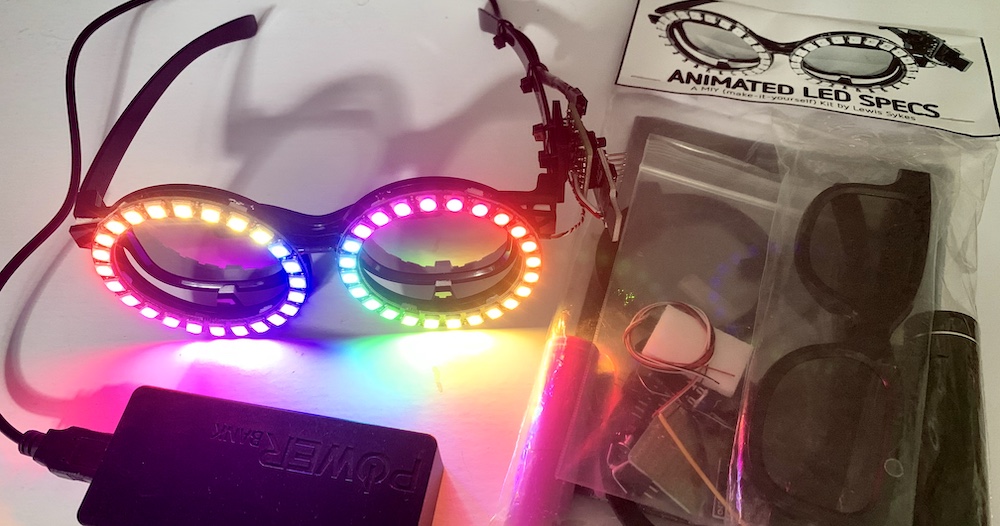
Animated LED Specs
Animated LED Specs are a pair of RealD 3D glasses fitted with two 24 LED RGB NeoPixel Rings driven by a compact microcontroller.
They make a great accessory for all types of futuristic fancy dress outfits; they’re perfect for visits to Light nights and festivals; and kids love them.
The original idea wasn’t mine, I take no credit. My MMU BA Creative Multimedia colleague and creative collaborator Ben Lycett prototyped them first. I replaced the original Teensy 3.2 with a cheaper and more compact microcontroller – the Atmel ATTiny85 (and later the Digistump – an ATTiny85 based development board with a USB interface as recommended by Mike Bratt of the HacMan makerspace) – and updated the PCB layout and laser cut mountings.
I developed them for a ‘hands-on’ workshop at Barclays Salford Eagle Lab as part of the outreach programming and development team for Illuminim – an interactive light-based artwork featuring up to 10 floating illuminated buoys that collectively create patterns of light in response to audience interaction – launched at Lightwaves 2018.
I subsequently showcased them at the Manchester MakeFest 2019 at the Science & Industry Museum, 25 May and also at Liverpool MakeFest 2019 at Liverpool Central Library, 29 Jun.
I also developed the project as a MIY (make-it-yourself) kit with accompanying instructables.com guide – though that’s still in progress.
I invested a fair amount of time working out how to optimise the code to fit within the modest 8k Flash memory (about 6k after bootloader) of the ATTiny85 and will post these details on my development blog in due course.
A demo video of the Animated LED Specs in action embedded below…